

Disability Pride is Resistance
Celebrating disability pride does not erase suffering, it challenges ableism

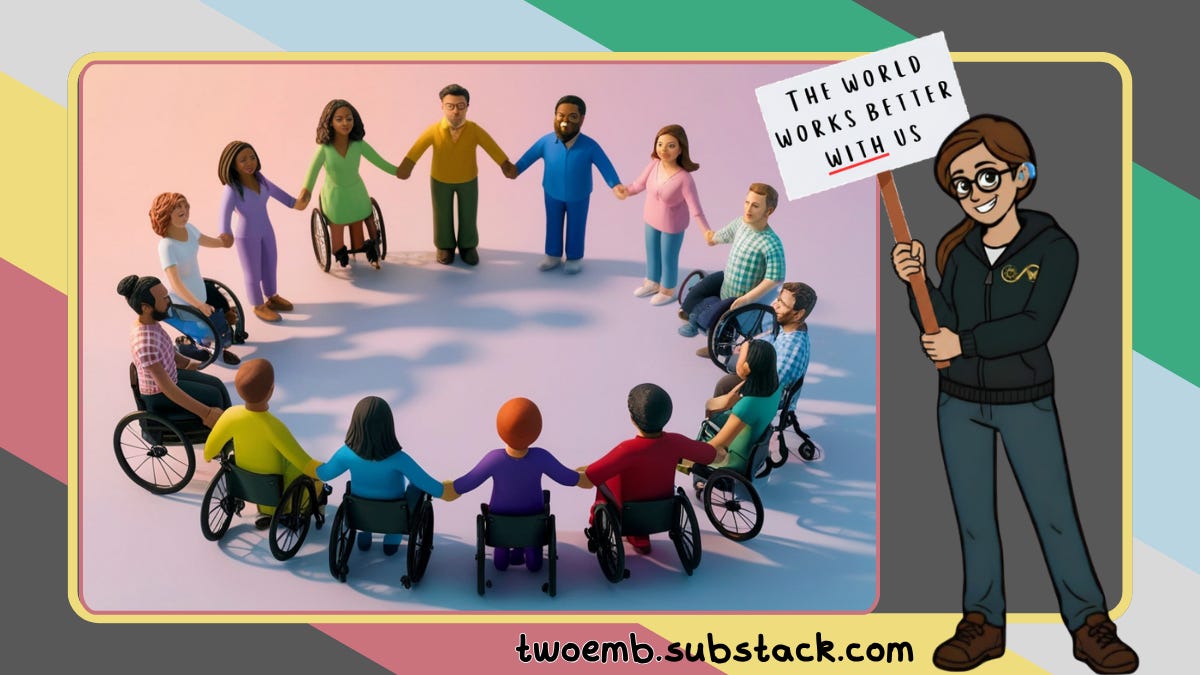
July is Disability Pride Month
July is disability pride month, and every year we see a few comments trickle in which claim the idea of disability pride creates the impression that disability doesn’t come with hardship. This accusation is ahistorical, and fails to consider the social and political roots of the disability rights movement. I’ll share a very brief overview of how and why we celebrate disability pride month each July.
Firstly, for our friends from the U.S.A. (condolences), July marks the month during which the Americans with Disabilities Act (ADA) came into effect in 1990. It was around this time that Critical Disabilities Studies (CDS) became more “mainstream”. While CDS emerged decades earlier, growing out of the Disability Civil Rights Movement of the 1960s and 1970s, it was in the 80s and 90s that its presence became formalized in public institutions such as Universities and discussed more widely in academic literature.
About a decade later, we saw Canadian provinces begin to adopt various legal acts which protect the rights of disabled people in both the public and private sectors, requiring government and businesses to offer accessible services. It was also around this time that the United Nations’ Convention on the Rights of Persons with Disabilities (UNCRPD) came into force.
It’s part of a social and political movement
Disability pride is not about pretending disability does not come with varying degrees of challenges, and for some, frequent pain and suffering. This is not about painting over the realities of disabled people with rose-coloured lacquer, or engaging in a form of toxic positivity which doesn’t acknowledge the hardships people experience. Disability pride is part of the broader Disability Rights movement. It’s about being open and honest regarding our experiences, pushing for accessibility and equitable treatment, and critiquing societal norms which devalue the lives of disabled people.
Disability pride highlights the importance of disabled people to our communities, calls out and challenges ableism, and demands that we be seen and heard as our true selves, not some watered-down version that is more palatable for the masses. Society often expects disabled people to be invisible, unless or until we can be exploited for the benefit of others. Disability pride and critical disability studies push back against this narrative, moving away from the individualized medical model, towards theories which examine and confront society’s deeply ingrained systemic ableism.
There’s a lot more depth and complexity than can be conveyed in a short blog-style article, but once you explore the rich history behind disability rights movements, you will find there is much more behind disability pride than donning pom-poms and pretending life is carefree.
Lastly, embracing our intersecting identities can help us unlearn internalized ableism and connect with others in our communities. Not only does being in community improve our quality of life, it also strengthens our ability to resist and fight back against ableism, discrimination, and mistreatment.
© Jillian Enright, Neurodiversity MB
Related articles
Decadence, Degeneracy, and Deviance
Liberating the Degenerates & Neuroqueers
Without Community There Is No Liberation
Ways to support my work
You can leave a “tip” on Ko-Fi at https://Ko-Fi.com/NeurodiversityMB
Become a paid subscriber to my Substack publication
Check out my online store at https://NeurodiversityMB.ca/shop
Read and share my articles from twoemb.medium.com
You can also follow me on facebook & Blue Sky, and find all my links on LinkTree
References
Ellis, K., Garland-Thomson, R., & Kent, M. (Eds.). (2019). Manifestos for the future of critical disability studies : volume 1. Routledge, Taylor and Francis Group.
McRuer, R., & Bérubé, M. F. (2006). Crip Theory : Cultural Signs of Queerness and Disability. NYU Press.